
I’ll be honest with you: I used to dread teaching Poe.
I was tasked with teaching Poe’s Fall of the House of Usher during my high school rotation for student teaching. I dreaded it, not because I didn’t love the stories— obviously its amazing, they’re Poe — but because i was forced to teach what had always been taught, which turned that delicious, creeping dread into a worksheet. Define “foreshadowing.” List three examples of symbolism. Answer in complete sentences. Those students trudged through “He House of Usher” like it was a chore instead of the fever dream it actually is.
While getting ready to teach my Bigs this fall all about Poe (after visiting his the Richmond museum last year with them) it hit me: Poe doesn’t want readers. Poe wants investigators.
His narrators lie to us. They insist they’re sane while confessing to murder. They hide bodies under floorboards and behind bricked-up walls and then dare us not to notice. That’s not comprehension-question material — that’s a case file waiting to be built.
So that’s what I built. Not one lesson, but a whole investigation into Poe — his stories, his poetry, and the man himself. I’m calling it The Poe Files, and I want to walk you through what’s inside.
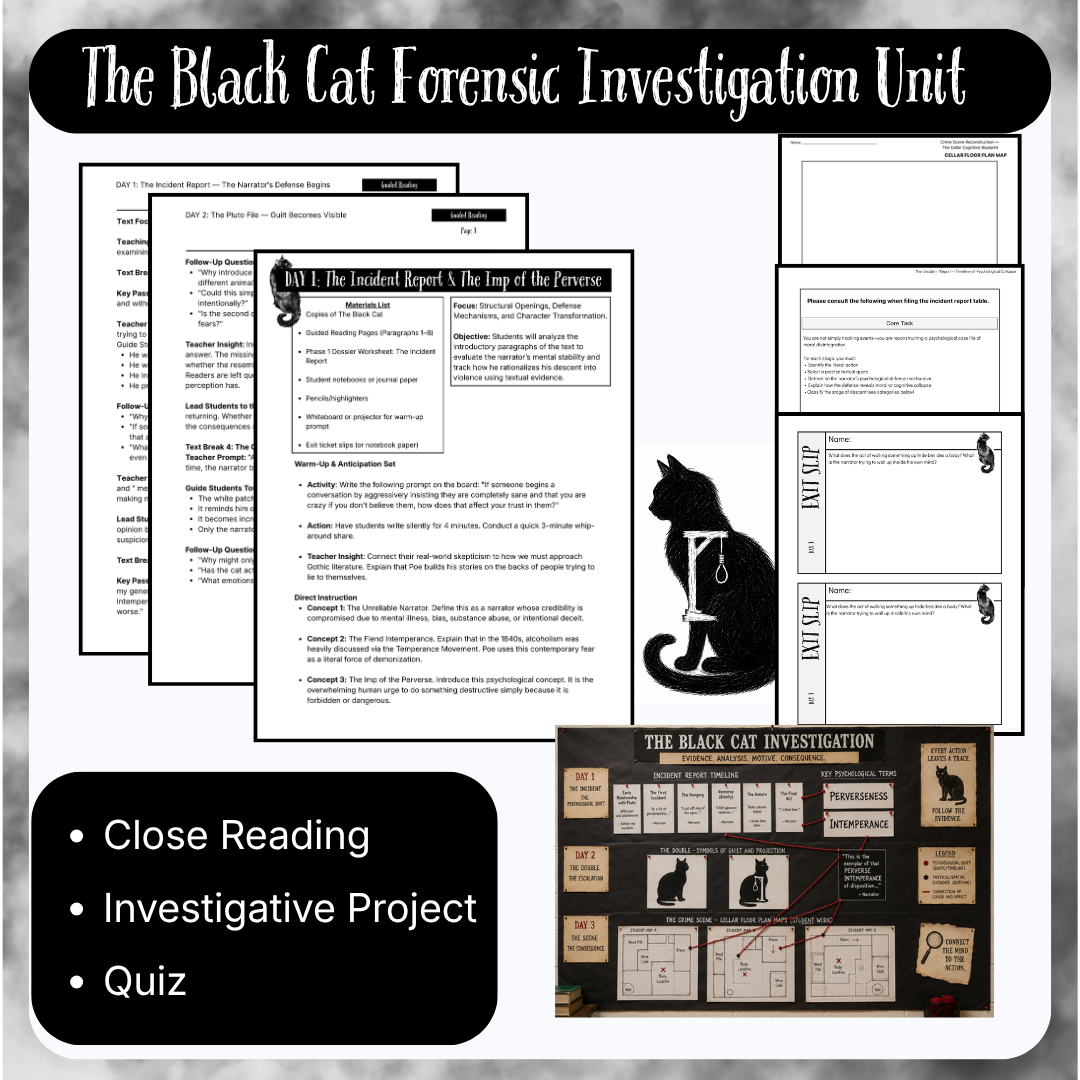
Case File #1: The Black Cat — Diagnosing a Narrator
This one started as an experiment: what if, instead of asking kids to summarize the narrator’s decline, we asked them to prove it?
Students build a forensic case file in four phases — Incident Report, Pluto File, Crime Scene Mapping, and Final Diagnosis — collecting textual evidence of the narrator’s psychological unraveling as they go. By the end, they’re not writing a book report. They’re arguing whether this man is criminally responsible or legally insane, backed by the text itself.
It comes with 5 full lesson plans, guided reading pages, scaffolded worksheets, a portfolio showcase activity, a peer rubric, a quiz, answer keys — and homeschool adaptations baked into every lesson, because I know not everyone reading this has 30 kids and a bell schedule.
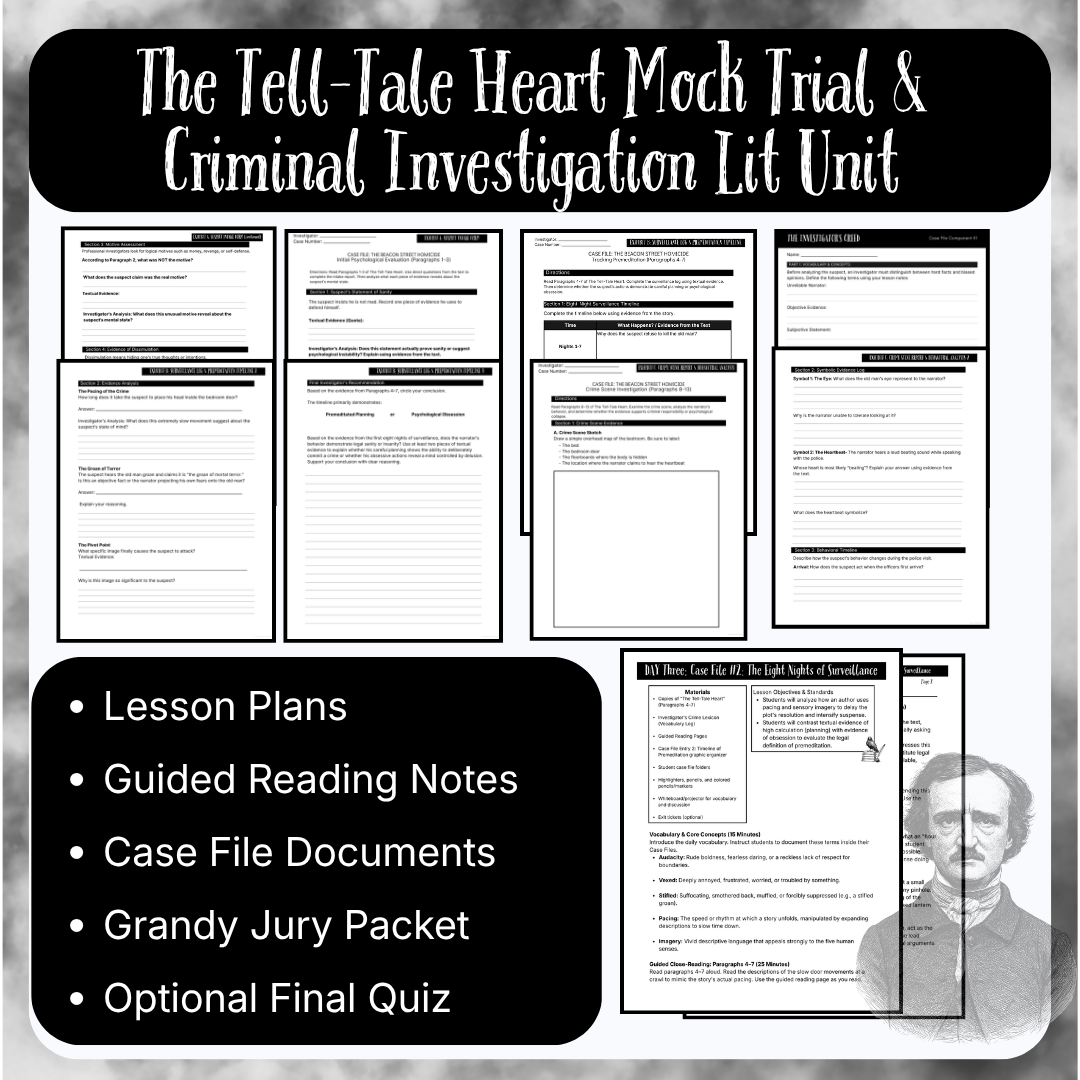
Case File #2: The Tell-Tale Heart — Bring the Courtroom In
If Black Cat is the diagnosis, this is the trial.
This 5-day unit turns your classroom (or your kitchen table) into an active investigation room. Students become forensic prosecutors, building a formal legal case file to determine whether the narrator is guilty of First-Degree Premeditated Murder — or Not Guilty by Reason of Insanity.
My favorite piece of this one is the custom Interrogation Transcript I wrote myself — a pre-reading suspect profile that teaches unreliable narration and objective vs. subjective reasoning before students ever open the story. By the time they hit Poe’s actual text, they already know what to watch for.
Inside: detailed day-by-day lesson plans with homeschool modifications, a vocabulary tracker, inconsistency log, timeline graphic organizer, crime scene evidence map, and a final Legal Brief assessment mapped to CCSS for grades 7–10.
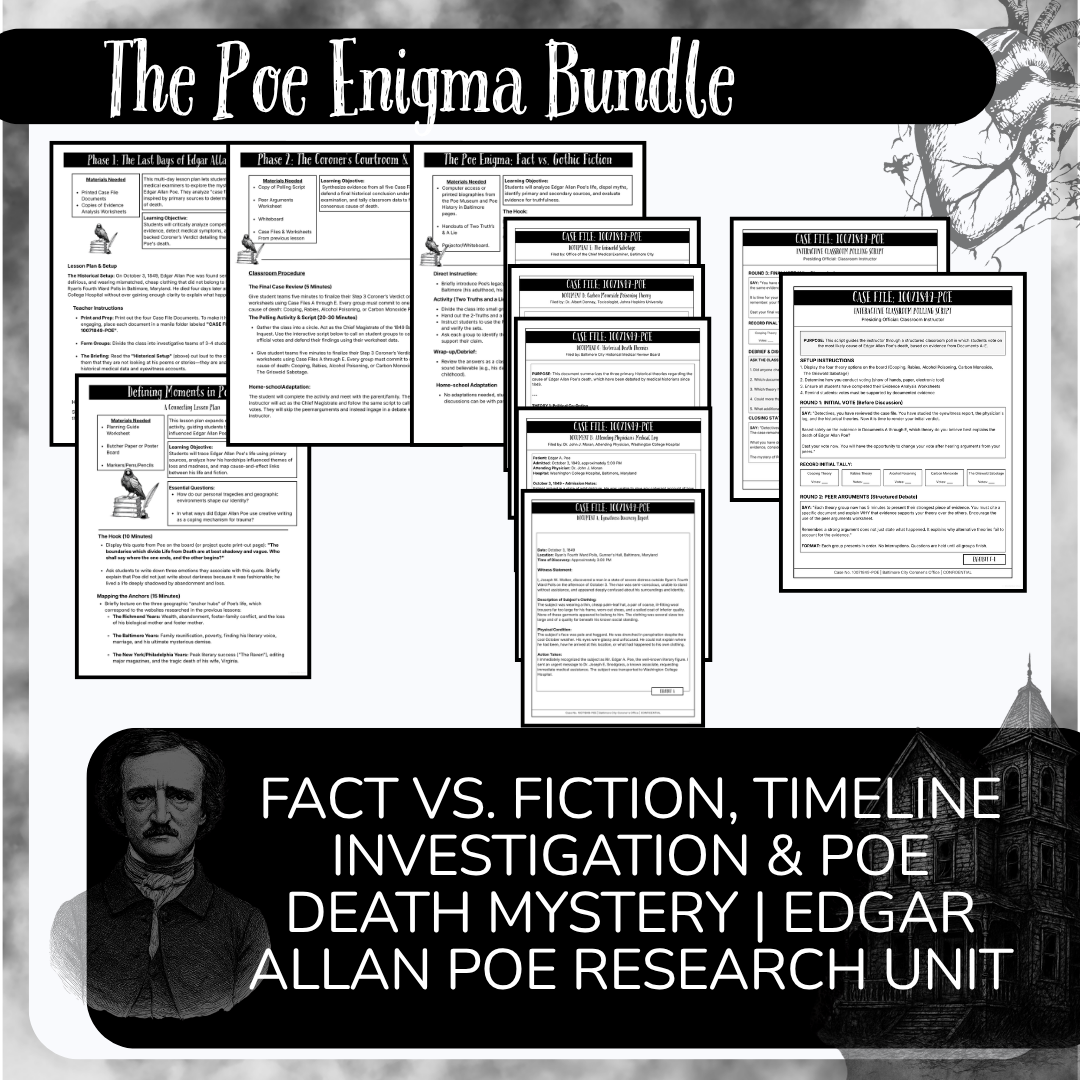
Case File #3: The Poe Enigma — Investigating the Man Himself
Here’s the thing about Poe: his life is just as strange as his fiction. He really did have unexplained connections to Richmond and Baltimore. He really did die under circumstances nobody has ever fully explained.
This mini-unit turns students loose on Poe’s biography the same way they investigated his narrators — separating fact from fiction, building a timeline, and holding a mock coroner’s courtroom to debate the mystery of his death. It’s a perfect companion piece if you want students to understand why a man who lived like this wrote what he wrote.
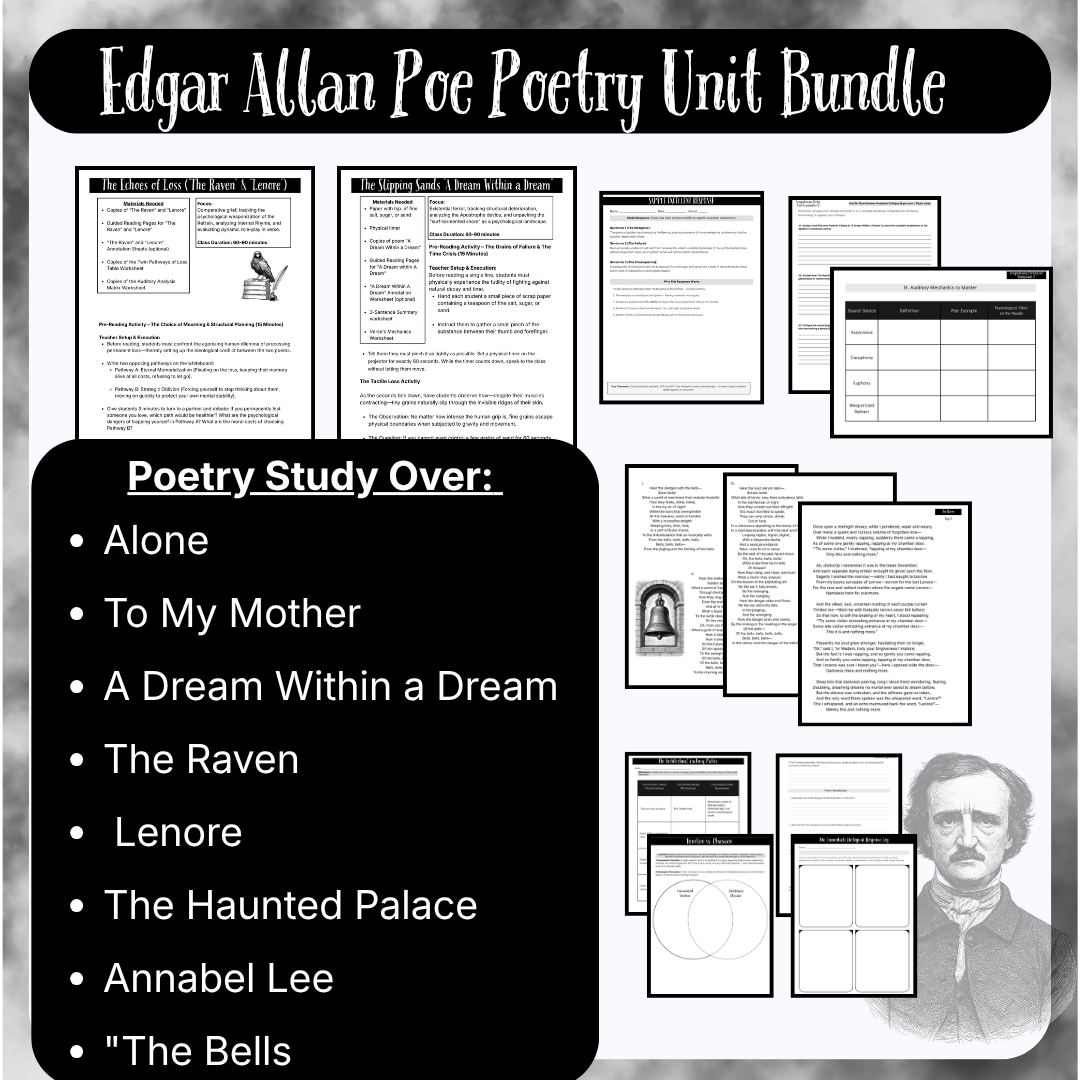
Case File #4: The Poetry Unit — Same Lens, New Evidence
Poe’s poetry gets the case-file treatment too. Across “The Raven,” “Annabel Lee,” “The Bells,” “Alone,” and five more, students analyze symbolism, sound devices, and structure while tracing themes of grief, obsession, and psychological unraveling — the same threads that run through his short stories.
At almost 60 pages of teacher and student materials, this is the most comprehensive piece of the collection, with guided readings, annotation pages, analysis matrices, a full study guide, and a unit exam.
Coming Soon to the Files
The investigation isn’t over. I’m currently building units for “The Cask of Amontillado” and “The Fall of the House of Usher” — so if revenge and decaying mansions are your thing, stay tuned.
How to Use These Together
You don’t have to run all four at once. A few ways I’d sequence it:
• Short story deep dive: Black Cat → Tell-Tale Heart, back to back, so students can compare two unreliable narrators building toward the same question — sane or guilty?
• Full author study: Poe Enigma first (get to know the man), then the short stories, then the poetry unit as a capstone.
• One-and-done enrichment: Any single unit stands alone if you just need one solid week of Poe.
Whichever way you go, every resource in the collection is print-and-go, comes with complete answer keys, and includes homeschool adaptations — because that’s how I build everything, for my own kids first.
Which Case Are You Ready to Crack Open?
Tell me in the comments — Black Cat, Tell-Tale Heart, or are you holding out for Amontillado? I’d love to know which mystery your students need most this year.