How Family Unit Studies Brings Us Together (and Builds Peaceful Independence)

How Family Unit Studies Brings Us Together (and Builds Peaceful Independence)

A few weeks ago I told you why we walked away from separate-subject, separate-child homeschooling and switched to family unit studies. This week, I want to show you what that actually looks like day to day — and why it’s done something I didn’t expect: it’s made my kids more independent, not less.

That surprised me. I assumed togetherness and independence pulled in opposite directions. It turns out they don’t. It instead brought about an ownership of independent skills, I did have to implement a structure to foster this and mod way through this year expectations and due dates are clearer and independent work is flourishing.

Why We Switched to Family Unit Studies (And the Curriculum That Made It Possible)

Why We Switched to Family Unit Studies (And the Curriculum That Made It Possible)

For the last years, (ever since adding Bird to our family in 2020) our homeschool day ran through me. Every subject, every child, every question — all of it funneled through one person standing at the center of the room, trying to be five places at once.

If you’ve homeschooled more than one child for more than one year, you already know exactly what I mean. It’s even beyond the school work too, it’s keeping up with two sets of kiddos, the Bigs (Mouse at 16 and  Thumper at 12) and  the Littles (Bird 5 and Bee 3).

How to Teach The Poe Files: A Sequencing Guide for Every Classroom (and Homeschool)

How to Teach The Poe Files: A Sequencing Guide for Every Classroom (and Homeschool)

Since I launched The Poe Files, the question I'm sure you are wondering  is some version of: “Okay, but where do I actually start?”

Fair question. Four resources, three short stories, eight poems, and one very mysterious biography is a lot of Poe. So I want to walk you through exactly how I’d sequence these — whether you’ve got a full semester to work with or just one week to fill.

Know Your Goal First

Before you touch a lesson plan, ask yourself one question: what are you actually trying to accomplish?

• A full author study — you want students to leave understanding Poe as a writer, not just knowing one story

• A short story deep dive — you want to spend real time comparing unreliable narrators and building analytical stamina

• One-and-done enrichment — you need a solid week of engaging content and nothing more

Your answer decides your path.

The Poe Files: A Case-by-Case Guide to Teaching Edgar Allan Poe (With Free Printable)

I’ll be honest with you: I used to dread teaching Poe.

I was tasked with teaching Poe’s Fall of the House of Usher during my high school rotation for student teaching. I dreaded it, not because I didn’t love the stories— obviously its amazing, they’re Poe — but because i was forced to teach what had always been taught, which turned that delicious, creeping dread into a worksheet. Define “foreshadowing.” List three examples of symbolism. Answer in complete sentences. Those students trudged through “He House of Usher” like it was a chore instead of the fever dream it actually is.

While getting ready to teach my Bigs this fall all about Poe (after visiting his the Richmond museum last year with them) it hit me: Poe doesn’t want readers. Poe wants investigators.

His narrators lie to us. They insist they’re sane while confessing to murder. They hide bodies under floorboards and behind bricked-up walls and then dare us not to notice. That’s not comprehension-question material — that’s a case file waiting to be built.

So that’s what I built. Not one lesson, but a whole investigation into Poe — his stories, his poetry, and the man himself. I’m calling it The Poe Files, and I want to walk you through what’s inside.


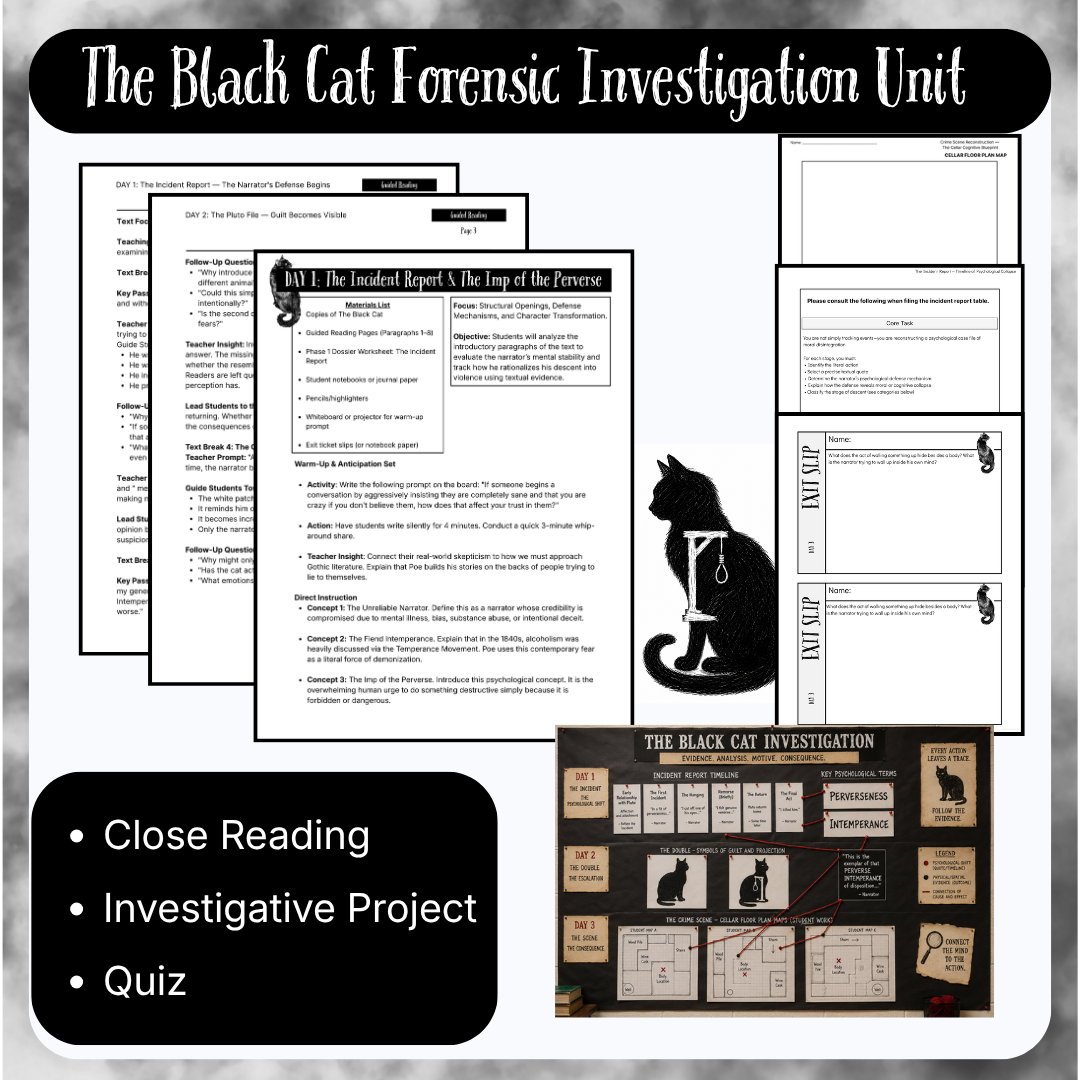
Case File #1: The Black Cat — Diagnosing a Narrator


This one started as an experiment: what if, instead of asking kids to summarize the narrator’s decline, we asked them to prove it?

Students build a forensic case file in four phases — Incident Report, Pluto File, Crime Scene Mapping, and Final Diagnosis — collecting textual evidence of the narrator’s psychological unraveling as they go. By the end, they’re not writing a book report. They’re arguing whether this man is criminally responsible or legally insane, backed by the text itself.

It comes with 5 full lesson plans, guided reading pages, scaffolded worksheets, a portfolio showcase activity, a peer rubric, a quiz, answer keys — and homeschool adaptations baked into every lesson, because I know not everyone reading this has 30 kids and a bell schedule.

Case File #2: The Tell-Tale Heart — Bring the Courtroom In


If Black Cat is the diagnosis, this is the trial.

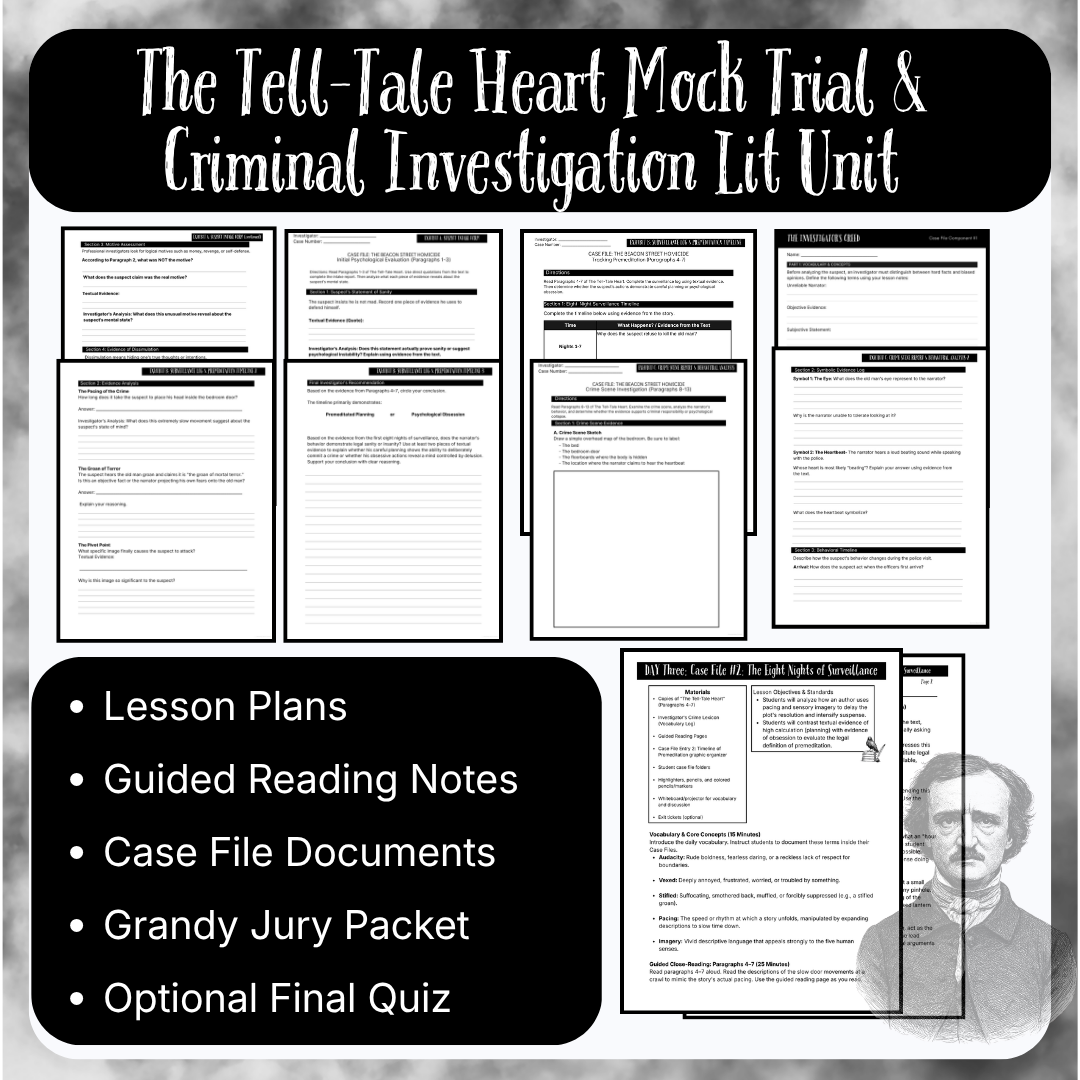
This 5-day unit turns your classroom (or your kitchen table) into an active investigation room. Students become forensic prosecutors, building a formal legal case file to determine whether the narrator is guilty of First-Degree Premeditated Murder — or Not Guilty by Reason of Insanity.

My favorite piece of this one is the custom Interrogation Transcript I wrote myself — a pre-reading suspect profile that teaches unreliable narration and objective vs. subjective reasoning before students ever open the story. By the time they hit Poe’s actual text, they already know what to watch for.

Inside: detailed day-by-day lesson plans with homeschool modifications, a vocabulary tracker, inconsistency log, timeline graphic organizer, crime scene evidence map, and a final Legal Brief assessment mapped to CCSS for grades 7–10.


Case File #3: The Poe Enigma — Investigating the Man Himself

Here’s the thing about Poe: his life is just as strange as his fiction. He really did have unexplained connections to Richmond and Baltimore. He really did die under circumstances nobody has ever fully explained.

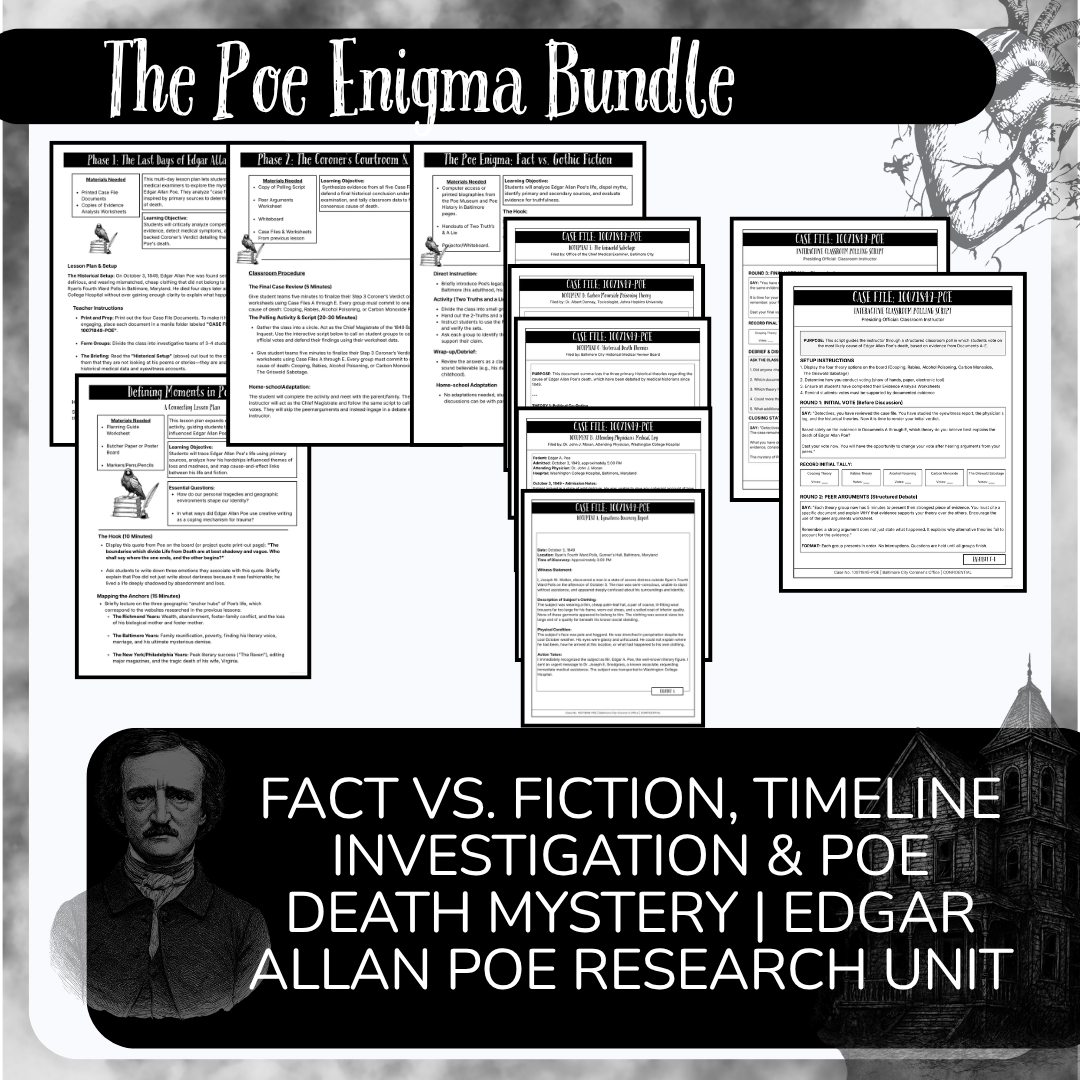
This mini-unit turns students loose on Poe’s biography the same way they investigated his narrators — separating fact from fiction, building a timeline, and holding a mock coroner’s courtroom to debate the mystery of his death. It’s a perfect companion piece if you want students to understand why a man who lived like this wrote what he wrote.

Case File #4: The Poetry Unit — Same Lens, New Evidence

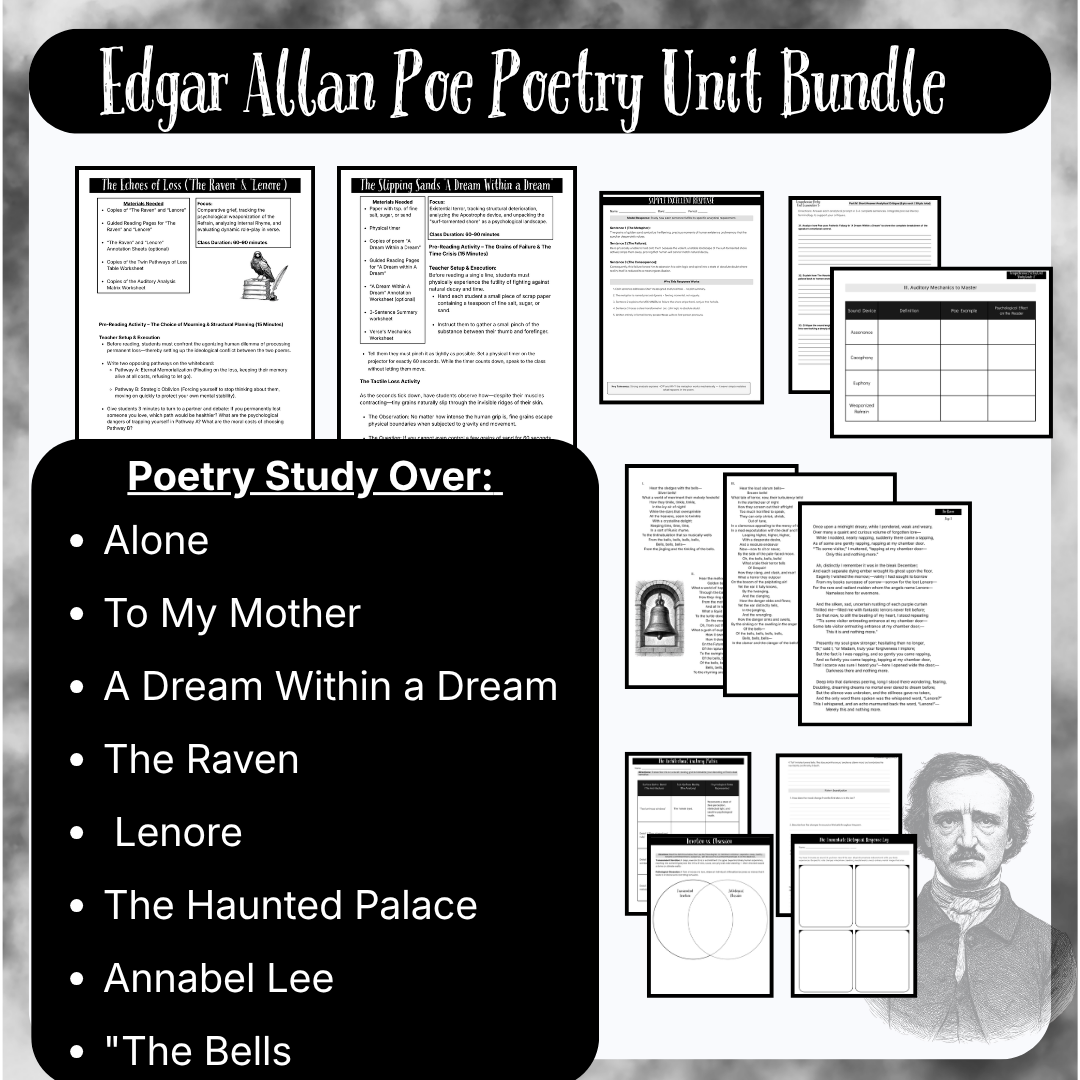
Poe’s poetry gets the case-file treatment too. Across “The Raven,” “Annabel Lee,” “The Bells,” “Alone,” and five more, students analyze symbolism, sound devices, and structure while tracing themes of grief, obsession, and psychological unraveling — the same threads that run through his short stories.

At almost 60 pages of teacher and student materials, this is the most comprehensive piece of the collection, with guided readings, annotation pages, analysis matrices, a full study guide, and a unit exam.


Coming Soon to the Files

The investigation isn’t over. I’m currently building units for “The Cask of Amontillado” and “The Fall of the House of Usher” — so if revenge and decaying mansions are your thing, stay tuned.

How to Use These Together

You don’t have to run all four at once. A few ways I’d sequence it:

• Short story deep dive: Black Cat → Tell-Tale Heart, back to back, so students can compare two unreliable narrators building toward the same question — sane or guilty?

• Full author study: Poe Enigma first (get to know the man), then the short stories, then the poetry unit as a capstone.

• One-and-done enrichment: Any single unit stands alone if you just need one solid week of Poe.


Whichever way you go, every resource in the collection is print-and-go, comes with complete answer keys, and includes homeschool adaptations — because that’s how I build everything, for my own kids first.


Which Case Are You Ready to Crack Open?

Tell me in the comments — Black Cat, Tell-Tale Heart, or are you holding out for Amontillado? I’d love to know which mystery your students need most this year.

Burnout, Boundaries, and Better Resources: What I Learned from My Blogging Hiatus

Burnout, Boundaries, and Better Resources: What I Learned from My Blogging Hiatus

You know that moment when something you genuinely love starts to feel like something you dread?

That's not a dramatic thing to admit. It happens slowly — so slowly you almost don't notice it. You start writing and then pause to wonder how it will land. You share something you're proud of and then brace yourself for the response. You open your laptop and sit there for a minute too long, trying to figure out where to start.

That was me, about six months ago. And instead of pushing through it, I did something I have done a few times — I stopped.

Momma Bear School Resources

Momma Bear School Resources

In case you are new to following us, I thought I would take the time to introduce Momma Bear School Resources to you. As a former teacher wannabe, I missed lesson planning and resource creation, so since 2018/19 I have dabbled in creating lesson plans and resources for our girls. In 2020, I began creating and offering to others the things I have been making and using in our homeschool journey.

2026 Homeschool Curriculum Choices: A Switch to Family Unit Studies and More

2026 Homeschool Curriculum Choices: A Switch to Family Unit Studies and More

Our new school year is here.   While most families are settling back into their home school rhythms from before the holidays, we begin our first official school day of the new school year. Curious as to why? Well, if you're new to following us, it is because we adopted a year-round homeschool schedule (which I go over in more depth HERE). Basically, because our yearly schedule is often unpredictable with travel, staying within a traditional school-year calendar (August to June) wasn't working out. While one shouldn't feel "behind" in one's homeschooling journey, I did, and it was overwhelming. I switched to a year-round calendar and began our year in January almost 6-7 years ago now, and haven't looked back. While we are no longer new to year-round schooling, we have decided to take a different approach to our school days this year. We have been (and I still am) a big fan of Sonlight History/Bible/Literature. It is no longer sustainable or a workable option for us. With three kiddos now needing instruction and time with me, and a 2-year-old running chaos amongst us, I was being pulled in six different directions, and our homeschool magic learning atmosphere was missing. Enter in family unit studies, a new approach to learning for us that I am excited to share with you as I share our curriculum choices for the 2026 school year.

The Legend of Sleepy Hollow: Full Family Unit Study

It's here, and I'm eager for us to get home and officially begin this unit. I've created a few multi-level unit studies for our Christmas School over the last few years. Still, around the end of August, I realized Thumper would be finishing up our core curriculum by the end of September, so I knew I needed something to fill up her time until we began the Thanksgiving unit I had already planned to use for November. I had had the idea in the back of my mind to do a Sleepy Hollow Unit Study in a year or two, but I decided to give it a shot and complete it this year once we returned to our home base for the winter holiday season. I worked some early mornings, took advantage of nap times, and seized work time whenever possible to complete this unit for us and others, with the goal of finishing it by October 1st. I met that goal, with a few days to spare.


I know I have a few high school essays I would like to add, and possibly some preschool materials to include, but I'm happy with what I've been able to accomplish and feel it will make for a pretty rich unit with what I currently have done.


The Big-Whole Family or Multi-level Classroom Unit is a 15-Day Unit study that breaks down the Reading of The Legend of Sleepy Hollow into 10 days, so that we can dive deep into the literature with profound family-group-centered lessons, end-of-lesson wrap-up activities, and multiple extension activities that have several (90+) optional worksheets available. Older students will challenge themselves independently using the Reading Journal portion of this study, where they will engage with journal entries, discussions, comprehension questions, and literary element reviews and extensions.


The learning doesn’t stop once we finish reading The Legend of Sleepy Hollow. Students will then complete a study guide tailored to their age level, which correlates with the final test at their respective level.  To celebrate the end of the unit, students will watch Disney’s The Legend of Sleepy Hollow and compare it to Irving’s text with a comparison guide. If that wasn’t enough, students can also let their creativity shine in one of the FIVE available projects with this unit. Elementary students can make a diorama of their favorite scene. At the same time, middle schoolers can choose to retell the story in a comic book or picture book remake, or they can become Sleepy Hollow tour guides with the Creepy Tour Guide Project. High schoolers can be challenged to build a Cold Case File for the missing Ichabod Crane or create a Modern TV adaptation.


To tie this unit together, I’m including a BONUS Legend of Sleepy Hollow-themed dinner with a Menu and recipes inspired by the story.


You can choose to purchase this complete family-group unit study or purchase some of the individual components instead/


Items Available Individually:

Look for an update/recap of how the unit goes for us at the end of October.


For now, this unit and any of the Legend of Sleepy Hollow projects can be purchased for 10% off using code SLEEPY25 on the website or with no code needed on my TPT storefront.

2025 Christmas School

2025 Christmas School

I announced this arrival WAY earlier on our Facebook Page and  Instagram pages, but I still needed to do things properly and announce it and dive deep into what's available here on the blog.

I have been creating resources for our Christmas School since 2020 (see what it is HERE). Initially, I started making it mainly for our older girls. Still, it has evolved and become significantly more over the last five years. This year's theme is Santa Claus. I have created two literature Studies, Two Essays, and one writing project around this theme for the 2025 school year.